

Elrock Capital arranges commercial real estate financing in Dallas-Fort Worth, including construction loans, bridge loans, permanent debt, preferred equity, mezzanine debt, and joint venture equity for projects from $10 million to more than $100 million. We match DFW sponsors with the private debt funds, family offices, banks, credit unions, life companies, and CMBS lenders most active in the Metroplex.
U.S. market to watch, ULI/PwC Emerging Trends 2026
Regional industrial inventory, among the largest in the nation
New residents added annually in recent years
Apartment units in the metro, among the largest U.S. inventories

Dallas-Fort Worth is the most active commercial real estate market in the country by nearly any measure, and the ULI/PwC Emerging Trends survey ranked it the number-one U.S. market to watch again for 2026. The Metroplex pairs the nation's fourth-largest metro population with one of its fastest growth rates, adding residents and corporate headquarters at a pace that keeps demand ahead of supply across most property types.For sponsors, that depth matters on the capital side as much as the leasing side. Virtually every national bank, life company, debt fund, and CMBS desk actively quotes DFW deals, and Texas regional banks and credit unions add another competitive layer. Elrock runs that full field on every assignment, from ground-up construction in the northern suburbs to recapitalizations inside the loop.
Corporate relocation and expansion remain the market's engine: the region hosts more than twenty Fortune 500 headquarters, and campuses from Goldman Sachs in Dallas to Charles Schwab and Fidelity in Westlake keep adding high-wage employment. DFW International Airport anchors one of the world's busiest passenger and cargo hubs, while the 27,000-acre AllianceTexas development in north Fort Worth functions as an inland port with air, rail, and highway connectivity.Farther north, Texas Instruments' multibillion-dollar fab buildout in Sherman and a wave of data center construction across the region add long-duration industrial and infrastructure demand. None of these drivers is cyclical, which is why lender appetite for DFW rarely thins even in slower national markets.
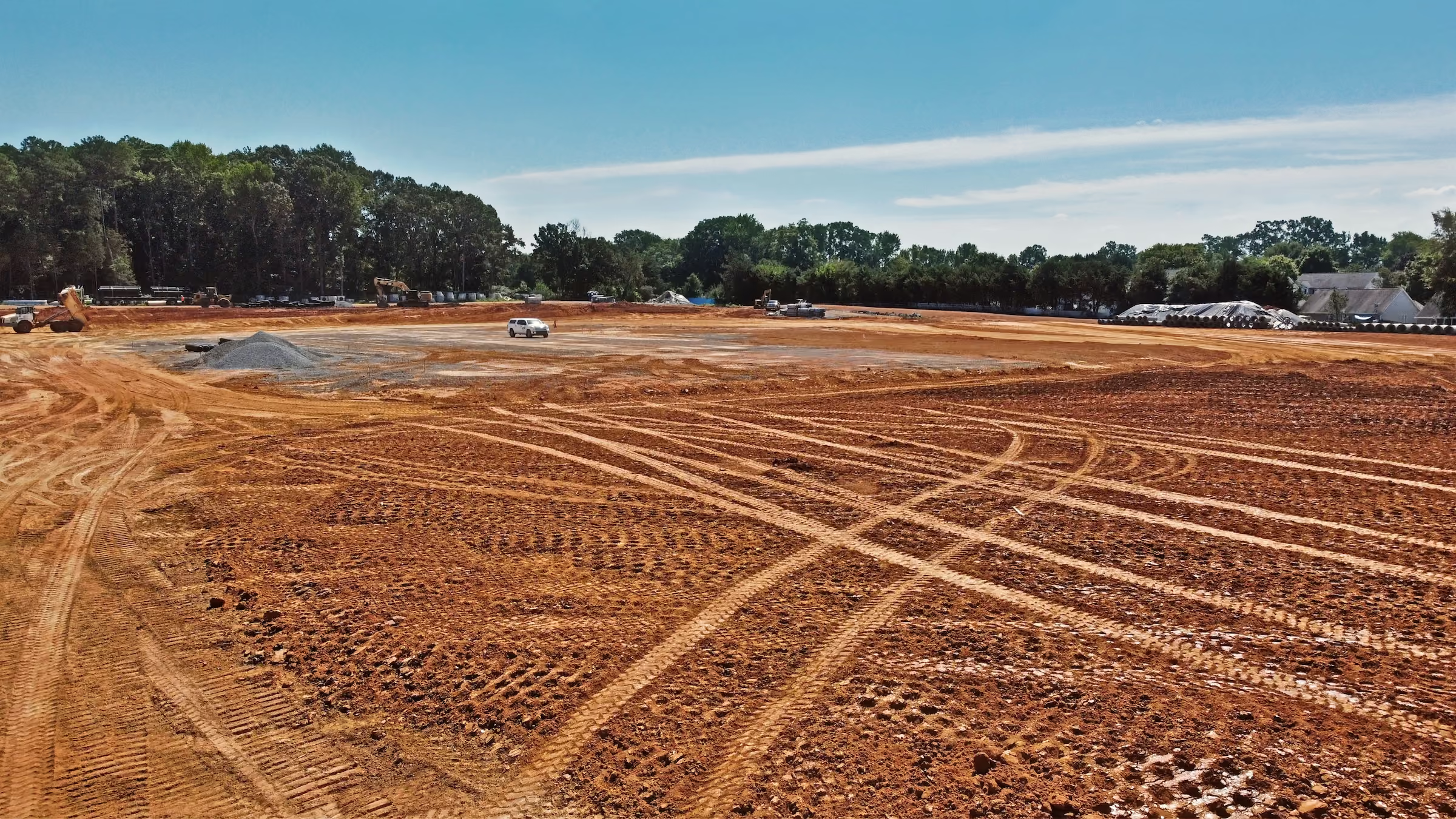

Multifamily and build-to-rent lead the pipeline, concentrated in high-growth corridors like Frisco, McKinney, Prosper, and Celina. Industrial demand centers on AllianceTexas and the South Dallas I-20 corridor, where the metro's inventory now exceeds one billion square feet. Office capital is selective but real for well-located product in Uptown and Legacy West, necessity retail continues to finance well across the suburbs, and single-family for-sale and land strategies remain financeable for experienced sponsors given the region's absorption.
AllianceTexas and north Fort Worth for logistics and manufacturing; the South Dallas I-20 corridor and Great Southwest in Arlington for bulk industrial; Legacy West, Frisco, and Plano for corporate campuses and mixed-use; Las Colinas and Irving for headquarters office; Uptown and Turtle Creek for institutional office and multifamily; and the McKinney-Prosper-Celina corridor for residential and retail growth. Each carries a distinct lender profile, which shapes how we position a deal before it goes to market.

Banks and credit unions remain the sharpest pricing on construction and stabilized deals where sponsors accept recourse; private debt funds and family offices cover non-recourse construction, bridge, and heavier value-add profiles; life companies compete hard for core permanent loans; and agency lenders and CMBS round out multifamily and retail or hospitality takeouts. Two Texas-specific underwriting notes matter on every DFW deal: property taxes are among the highest in the country and lenders size to post-sale reassessment, and insurance costs have become a standard sensitivity in DSCR modeling. We build both into sizing with lenders up front.

Elrock arranges construction loans, bridge loans, permanent financing, subordinate financing such as preferred equity and mezzanine debt, and joint venture equity across the Metroplex, typically on projects from $10 million to more than $100 million and selectively lower.
Texas has no state income tax but carries some of the highest commercial property taxes in the country, so lenders underwrite to post-acquisition reassessment rather than the seller's current tax bill. We model reassessed taxes and insurance into DSCR sizing before a deal goes to market so terms do not move late in the process.
Yes. Banks, credit unions, and private debt funds are all active on ground-up multifamily, build-to-rent, and mixed-use projects in the northern growth corridor, with leverage up to roughly 85 percent of cost or higher depending on sponsor track record, submarket, and presales or preleasing.
DFW draws the deepest lender field of any U.S. market: national and Texas regional banks, credit unions, private debt funds, family offices, life insurance companies, CMBS desks, and agency lenders for multifamily. That competition is a structural advantage for sponsors on both pricing and structure.
Yes. Representative transactions include Pine Heights, a $54 million new-construction multifamily financing in Dallas. Details on recent closings are available on our homepage or by request.

